IWAENC 2026

PathRIR: Physics-Guided Acoustic Path Selection and Late-Tail Compensation for Fast Room Impulse Response Simulation

Shaoheng Xu1,∗,†, Chunyi Sun1,∗, Jihui (Aimee) Zhang2,1, Amy Bastine1, Prasanga N. Samarasinghe1, Thushara D. Abhayapala1

1 The Australian National University, Australia 2 The University of Queensland, Australia ∗ Equal contribution † Corresponding author

Pyroomacoustics (Pyroom) simulates room impulse responses (RIRs), which describe how sound travels and echoes in a room. These simulations become slower as more repeated reflections are included.

PathRIR speeds up this process in two steps: it learns to keep the most important sound paths, then adds back the missing energy in later echoes. This can reduce simulation time from minutes to milliseconds.

Listening test1

Clean Speech

Dry speech · 16 kHz mono · 30 s

Convolved with Pyroom

Full image-source tree, no pruning

Convolved with PathRIR

Pruned image-source tree + compensation tail

Clean Music

Dry music · 16 kHz mono · 33 s

Convolved with Pyroom

Full image-source tree, no pruning

Convolved with PathRIR

Pruned image-source tree + compensation tail

Image Sources Retained by PathRIR2

Image-source positions around a room: every node found by full-order ISM in pale purple, the small subset PathRIR keeps in red. PDF Download

Key results3

90.5%of image-source nodes removed relative to full-order ISM
279×faster than Pyroomacoustics
42,133×faster than our full-order ISM implementation
  1. Demo 4 · 16 kHz · Omax = 16 · no retraining
  2. Illustrative room from the paper
  3. Paper, Table 2 · 20-room test set · Omax = 10 · Intel Xeon Gold 6342 + NVIDIA A100

Overview

Architecture

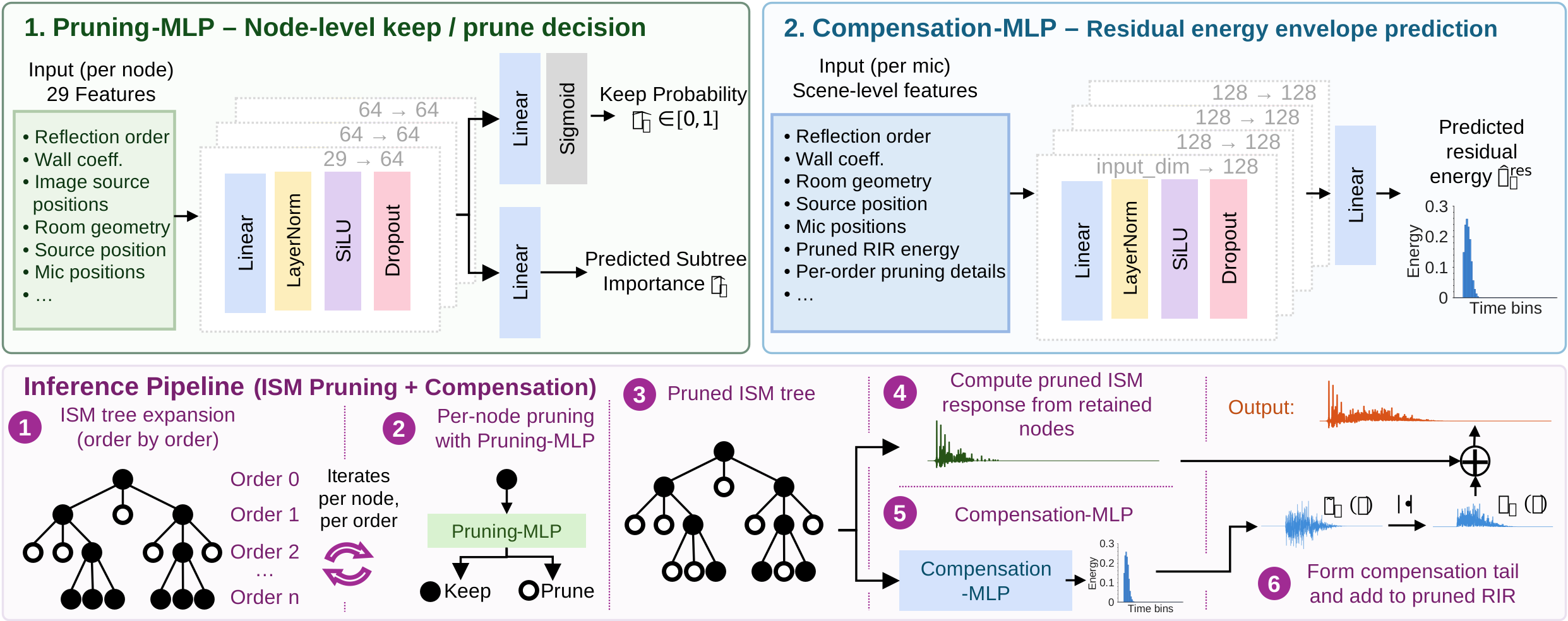
PathRIR pipeline: order-wise ISM expansion with a Pruning-MLP keep/prune decision per node, followed by a Compensation-MLP that predicts the residual energy envelope used to shape the compensation tail.
Fig. 1. How PathRIR works. The Pruning-MLP selects the most important sound paths. A physics-based simulator uses these paths to compute the RIR. The Compensation-MLP estimates the missing energy in later echoes. A compensation tail adds this energy back to the RIR.

Abstract

Image-source-method (ISM)-based room impulse response (RIR) simulation is a useful and physically interpretable tool for acoustic scene modeling, but full-order ISM becomes computationally expensive as the reflection order and room complexity increase. We propose a physics-guided framework for fast RIR simulation that preserves the geometric structure of ISM while learning to retain only acoustically important image-source paths during online traversal. To recover energy removed by pruning, the proposed PathRIR uses a lightweight compensation multilayer perceptron to predict the missing late-tail energy envelope and generate a compensation tail whose energy follows that envelope. Experiments on irregular 3D rooms show that PathRIR reduces image-source computation and improves runtime efficiency over a full-order ISM simulator, while achieving low waveform- and decay-related errors. Ablation results show that adding the compensation tail improves waveform fidelity and reduces energy-decay-curve error, reverberation-time error, and direct-to-reverberant-ratio error, with modest runtime overhead.

Four Demos

  • Demos 1–2 use settings within the ranges tested in the paper.
  • Demos 3–4 use the same room layout but go beyond the training limits: a higher sampling rate (more audio samples per second) and more repeated sound reflections.
  • No models were retrained.
Standard #1

A room where echoes fade quickly

The surfaces absorb more sound than in the other demos, so echoes fade quickly. PathRIR closely follows the sound decay predicted by Pyroom.

  • Walls 8
  • Floor 26.0 m²
  • Height 3.0 m
  • Volume 78 m³
  • Absorption 0.50
  • Source–mic 2.84 m
  • Reflection order 10
  • Sampling rate 8 kHz
  • RIR duration 0.5 s

Listening test

Clean Speech

Dry speech · 8 kHz mono · 30 s

Convolved with Pyroom

Full image-source tree, no pruning

Convolved with PathRIR

Pruned image-source tree + compensation tail

Clean Music

Dry music · 8 kHz mono · 33 s

Convolved with Pyroom

Full image-source tree, no pruning

Convolved with PathRIR

Pruned image-source tree + compensation tail

Accuracy and Efficiency vs. Pyroom

Apple M1 Max · mean of 3 runs
Metric PathRIR w/o Comp-MLP
Cosine distance waveform shape error 0.057 0.079
NMSE waveform numerical error -9.51 dB -8.16 dB
EDC error 1.67 dB 9.96 dB
RT60 error 30.1 ms 107.5 ms
DRR error 0.35 dB 1.07 dB
Runtime 126 ms
Speedup compared to Pyroom 124.5×
Room configuration, Standard 1 PDF Download
Time-domain RIR, Standard 1 PDF Download
Energy decay curve, Standard 1 PDF Download
Short-time Fourier transform, Standard 1 PDF Download
Standard #2

A smaller room where echoes last longer

This room is smaller than Demo 1, but its surfaces absorb less sound and echoes last longer. This tests how well PathRIR restores energy in later echoes.

  • Walls 7
  • Floor 19.5 m²
  • Height 2.5 m
  • Volume 49 m³
  • Absorption 0.30
  • Source–mic 2.24 m
  • Reflection order 10
  • Sampling rate 8 kHz
  • RIR duration 0.5 s

Listening test

Clean Speech

Dry speech · 8 kHz mono · 30 s

Convolved with Pyroom

Full image-source tree, no pruning

Convolved with PathRIR

Pruned image-source tree + compensation tail

Clean Music

Dry music · 8 kHz mono · 33 s

Convolved with Pyroom

Full image-source tree, no pruning

Convolved with PathRIR

Pruned image-source tree + compensation tail

Accuracy and Efficiency vs. Pyroom

Apple M1 Max · mean of 3 runs
Metric PathRIR w/o Comp-MLP
Cosine distance waveform shape error 0.190 0.211
NMSE waveform numerical error -3.92 dB -4.16 dB
EDC error 3.07 dB 16.56 dB
RT60 error 19.1 ms 42.8 ms
DRR error 0.53 dB 3.27 dB
Runtime 121 ms
Speedup compared to Pyroom 100.2×
Room configuration, Standard 2 PDF Download
Time-domain RIR, Standard 2 PDF Download
Energy decay curve, Standard 2 PDF Download
Short-time Fourier transform, Standard 2 PDF Download
Out-of-Range #1

Beyond the training settings

PathRIR was trained at a sampling rate of 8 kHz and up to 10 reflections per sound path. This demo uses 16 kHz and up to 15 reflections, without retraining.

  • Walls 5
  • Floor 24.0 m²
  • Height 3.0 m
  • Volume 72 m³
  • Absorption 0.30
  • Source–mic 3.04 m
  • Reflection order 15
  • Sampling rate 16 kHz
  • RIR duration 0.5 s

Listening test

Clean Speech

Dry speech · 16 kHz mono · 30 s

Convolved with Pyroom

Full image-source tree, no pruning

Convolved with PathRIR

Pruned image-source tree + compensation tail

Clean Music

Dry music · 16 kHz mono · 33 s

Convolved with Pyroom

Full image-source tree, no pruning

Convolved with PathRIR

Pruned image-source tree + compensation tail

Accuracy and Efficiency vs. Pyroom

Apple M1 Max · mean of 3 runs
Metric PathRIR w/o Comp-MLP
Cosine distance waveform shape error 0.144 0.215
NMSE waveform numerical error -5.72 dB -4.13 dB
EDC error 5.51 dB 19.03 dB
RT60 error 121.3 ms 162.9 ms
DRR error 1.45 dB 2.97 dB
Runtime 73 ms
Speedup compared to Pyroom 4,377.3×
Room configuration, Out-of-Range 1 PDF Download
Time-domain RIR, Out-of-Range 1 PDF Download
Energy decay curve, Out-of-Range 1 PDF Download
Short-time Fourier transform, Out-of-Range 1 PDF Download
Out-of-Range #2

More reflections in the same room

This demo keeps the room layout and 16 kHz sampling from Demo 3. The source and microphone are closer, and paths can include up to 16 reflections. Pyroom takes over 20 minutes per RIR; PathRIR takes 136 ms.

  • Walls 5
  • Floor 24.0 m²
  • Height 3.0 m
  • Volume 72 m³
  • Absorption 0.30
  • Source–mic 1.45 m
  • Reflection order 16
  • Sampling rate 16 kHz
  • RIR duration 0.5 s

Listening test

Clean Speech

Dry speech · 16 kHz mono · 30 s

Convolved with Pyroom

Full image-source tree, no pruning

Convolved with PathRIR

Pruned image-source tree + compensation tail

Clean Music

Dry music · 16 kHz mono · 33 s

Convolved with Pyroom

Full image-source tree, no pruning

Convolved with PathRIR

Pruned image-source tree + compensation tail

Accuracy and Efficiency vs. Pyroom

Apple M1 Max · mean of 3 runs
Metric PathRIR w/o Comp-MLP
Cosine distance waveform shape error 0.125 0.186
NMSE waveform numerical error -6.31 dB -4.71 dB
EDC error 3.43 dB 19.23 dB
RT60 error 124.9 ms 169.5 ms
DRR error 1.48 dB 3.01 dB
Runtime 136 ms
Speedup compared to Pyroom 9,041.1×
Room configuration, Out-of-Range 2 PDF Download
Time-domain RIR, Out-of-Range 2 PDF Download
Energy decay curve, Out-of-Range 2 PDF Download
Short-time Fourier transform, Out-of-Range 2 PDF Download

BibTeX

@misc{xu2026pathrir_arxiv,
  title         = {{PathRIR}: Physics-Guided Acoustic Path Selection and
                   Late-Tail Compensation for Fast Room Impulse Response Simulation},
  author        = {Xu, Shaoheng and Sun, Chunyi and Zhang, Jihui and
                   Bastine, Amy and Samarasinghe, Prasanga N. and
                   Abhayapala, Thushara D.},
  year          = {2026},
  eprint        = {2607.23293},
  archivePrefix = {arXiv},
  primaryClass  = {eess.AS},
  url           = {https://arxiv.org/abs/2607.23293}
}

References & credits

  1. R. Scheibler, E. Bezzam, and I. Dokmanić, “Pyroomacoustics: A Python package for audio room simulation and array processing algorithms,” in Proc. IEEE Int. Conf. Acoust., Speech Signal Process. (ICASSP), 2018, pp. 351–355. Reference simulator for every “Pyroom” result on this page. github.com/LCAV/pyroomacoustics
  2. M. R. Schroeder, “New method of measuring reverberation time,” J. Acoust. Soc. Am., vol. 37, no. 3, pp. 409–412, 1965. Used for computing the energy decay curves.
  3. C. K. A. Reddy, E. Beyrami, J. Pool, R. Cutler, S. Srinivasan, and J. Gehrke, “A scalable noisy speech dataset and online subjective test framework,” in Proc. Interspeech, 2019, pp. 1816–1820. Source of the clean speech signal used in every listening test. github.com/microsoft/MS-SNSD